


The best nursery closet is built around how a baby’s clothes and supplies actually behave: short hanging items, lots of small folded pieces, and a new size every few months. Two rods at different heights, drawers, a deep top shelf and a spot for diapers within arm’s reach will do more than any decor. If you want those pieces cut to your exact closet, a custom system designed in 3D gets you there with the least wasted space. We design and build those systems locally in San Diego.
TL;DR
- Baby clothes hang only about 20 to 24 inches versus 40 to 60 inches for adult clothes, so a single standard rod wastes nearly half the vertical space. Two rods fix that.
- Give every part of the closet one job: current sizes on the rod, drawers for small items, the top shelf for future sizes and keepsakes, the door for grab-and-go supplies.
- Design for the next stage, not just the newborn months. Adjustable shelves and removable drawers let the same closet serve a toddler and then a school-age kid.
- A closet can hold the changing station too, which frees up bedroom floor space in smaller San Diego homes and condos.
- Reach-in systems from us start at $700, and full custom closets start at $3,000, with a free in-home 3D design consultation.
Table of Contents
- Start with the problem: a nursery closet is not an adult closet
- Double the hanging space
- Add drawers inside the closet
- Use the top shelf as deep storage
- Make the closet door do work
- Build a changing station into the closet
- Design for the next stage, not just the newborn months
- Keep the system working: a rotation habit
- Make it look good: color, bins and finishes
- What to do with a very small nursery closet
- Quick plan: what goes where
- Perspective: why we design nursery closets as the first of several stages
- Get a nursery closet designed for your home
- FAQ
- Sources
Start with the problem: a nursery closet is not an adult closet
Most builder-grade closets come with one rod and one shelf. That setup suits a rack of adult shirts and long coats. A nursery has the opposite needs. Onesies, sleepers and tiny dresses hang at about half the length of adult clothes, so the space under them goes unused. Meanwhile the items you reach for ten times a day, like diapers, wipes, burp cloths and spare outfits, have nowhere convenient to live.
The fix is not more bins. It is changing the geometry of the closet so each category of item has a home at the height you use it. Everything below follows from that idea.
Double the hanging space
This is the single biggest gain in a nursery closet. A second rod hung below the first turns one wasted column of air into a full second row of hanging clothes.
This Old House advises mounting two rods: one well above eye level for longer garments and one roughly 3 feet off the floor for shorter pieces. It also says to set both at least 1 foot from the back wall so hangers swing freely. For a standard closet, the common double-hang heights are 80 inches and 40 inches, which we break down in our guide to closet rod height.
A practical way to use the two rods:
- Upper rod: next sizes up, plus the occasional dress or coat that is longer.
- Lower rod: current sizes, at a height where you can grab an outfit without stretching.
Separate sizes with labeled dividers: newborn, 0 to 3 months, 3 to 6, 6 to 12, then “next size.” HGTV’s nursery guide suggests dividers by size and pinning matching sets together on one hanger, which saves a lot of morning guesswork.
One consideration specific to a custom build: the lower rod height is something you can fit to your own height and to the closet’s depth. Fixed hardware from a kit is set by the package. A system measured and drawn for your closet puts the rods exactly where you need them.
Add drawers inside the closet
Hanging space is only half the story. A newborn wardrobe is mostly folded: socks, bodysuits, swaddles, hats, mittens. These belong in drawers, and drawers inside the closet keep them out of the bedroom.
Ideas that work well:
- Drawers by type. Put diapers and wipes in the top drawer so they are the first thing you reach. HGTV recommends organizing drawers by type with diapers on top.
- Fold onesies vertically. HGTV’s folding method has you fold the onesie in half with sleeves touching, tuck the sleeves, fold the bottom up and file it on its edge so you can see every piece at once.
- Divided cells for tiny things. Socks, mittens and hair bows disappear in a deep drawer. Shallow dividers keep them findable.
- A “too small” and “too big” basket. Outgrown clothes and next-year clothes get their own containers so they never mix with what the baby wears now.
Built-in drawers have an advantage over a freestanding dresser: they are sized to the closet width, so there is no gap on either side and no wobbly furniture to worry about. If you do use a freestanding dresser or tall bookcase, Public Storage’s nursery guide says to anchor it following the manufacturer’s instructions and keep cords and hanging items out of the baby’s reach. That is a safety step to take with any furniture in a baby’s room.
Use the top shelf as deep storage
The space above the upper rod is easy to ignore, but it is where the things you need rarely should live. Good candidates are bulk diapers (taken out of the packaging to save room), next-year clothes, keepsakes and seasonal items like a bulky stroller cover.
Bark and Chase recommends fabric bins with clear label windows on that top shelf, and suggests avoiding clear plastic bins in a closet without doors, since the visible contents add visual noise. If your closet has no doors or you plan to leave them open, this is worth remembering.
A deeper top shelf, or two shelves stacked, can double what fits above the rod. In a custom system we can set that shelf height to your ceiling and your reach, so the heaviest bins sit where you can lift them safely.
Make the closet door do work
The back of the door is free real estate. An over-the-door organizer holds the grab-and-go items you want within a second: diaper packs, wipes, a thermometer, nail clippers, a spare pacifier. The Practical Nursery describes this as a no-drill option, with each part of the closet assigned one job.

If you prefer a closer look, sliding and mirrored closet doors also change how a nursery closet works. Sliding doors need no swing clearance, which matters in a small bedroom where a crib sits near the closet. We offer closet doors as part of a closet project, so the doors and interior are planned together.
Build a changing station into the closet
In a small room, the closet can become the changing area. This is sometimes called a “clursery” when the closet doubles as a baby nook. A changing pad sits on top of a dresser or drawer unit inside the closet, diapers and wipes sit in the drawers right below, and the hanging clothes are beside it. You never walk across the room to grab a fresh outfit mid-change.
What makes this work:
- A countertop at comfortable height. Usually around standard dresser height, with a lip or rail if you plan to use a changing pad.
- Drawers directly under the pad. Diapers, wipes, cream and spare clothes in the first two.
- Hanging space beside it, not above it. You do not want a rod directly over the changing surface where you could bump your head.
- Good light. A closet is a dark place by default. Plan for a light before you plan for decor.
- Pegboard or a mirror. Happiest Baby notes a mirror behind the changing area makes the closet feel larger, and a pegboard can hold headbands, photos and diaper cream.
This layout is where a custom build pays off most. The changing surface, drawer stack and rods all have to fit the closet’s exact width and depth, and a gap of an inch or two is the difference between a clean built-in and an awkward add-on. Before you commit, a 3D rendering of the closet system lets you see how the changing station, drawers and rods fit together. We do this as part of our free design consultation, in 3D, so you can walk through the plan before anything is built.
Design for the next stage, not just the newborn months
A baby closet is in use for a very short time as a baby closet. By age two or three it is a toddler closet, and by five it holds school clothes, shoes, sports gear and toys. The mistake is to design for the newborn and then tear it out.
The approach we recommend: build around adjustability.
- Adjustable shelves that can move up as stacks of folded clothes get taller or down as the child needs to reach.
- Rods that move. The double-hang setup for baby clothes can become a lower rod a child can reach on their own.
- Drawers that can be added or removed. Baby drawers hold diapers today and sweatshirts, toys or sports gear later.
- Open floor space. Keep part of the bottom section open or modular so a bin, a hamper or a shoe rack can slot in later. Our shoe storage ideas cover options as kids’ feet multiply.
The point is that an adjustable closet is reconfigured, not replaced. The same cabinet carcass works for years, and you only change the inside.
Keep the system working: a rotation habit
Organization fails when every size and season ends up in the closet at once. A simple rotation prevents it.
- Keep only current and next size within reach.
- Store outgrown and future sizes in flat, labeled bins on the top shelf.
- Keep a donation bin in the closet at all times so outgrown clothes leave the house instead of piling up.
- At each size change, bring the next size down to the rod and move the outgrown size up or out.
Also resist the urge to fill the space just because you have it. A well-designed closet makes it easy to see what you own, which is the best defense against buying duplicates of things you already have.
Make it look good: color, bins and finishes
A nursery closet is often visible when the door is open, so looks matter. The Spruce recommends matching bins for a cohesive look that prevents clutter, expandable dividers to compartmentalize deep drawers, and floor-to-ceiling shelves with decorative bins.
A few design choices that tend to work:
- A single color family. All-white shelving, bins and hangers reads as calm and streamlined. A color-coded rainbow arrangement is a more playful option, as Happiest Baby notes.
- Uniform hangers. Slim, matching hangers save width on the rod and look tidier.
- Lighting inside the closet. It makes both the function and the finish better.
- A finish that wipes clean. Nurseries get spit-up, diaper cream and sticky fingers. A smooth, durable surface is easier to keep clean than raw wood or open wire.
What to do with a very small nursery closet
If you have a reach-in closet barely wider than a door, the same logic applies, just with tighter choices:
- Go to double rods first. It is the biggest gain for the least space.
- Replace a single wire shelf with a deeper, sturdier top shelf.
- Add hooks at the back or side for hats, bibs and the diaper bag.
- Use the floor, either for a short drawer unit or labeled bins, and keep a clear path to the rod.
- Use the door for grab-and-go items.
Here is where a fitted system matters more than anywhere else. In a reach-in that is 4 or 5 feet wide, every inch counts, and standard-size parts leave gaps. Our reach-in systems start at $700, and our small closet organization guide walks through twelve fixes that add real space. For a hall or linen closet that will store spare bedding and supplies, see our guides to hall closet organization and linen closet organization.
Quick plan: what goes where
| Zone | What belongs there | Why |
|---|---|---|
| Top shelf | Bulk diapers, next-year clothes, keepsakes, seasonal items | Rarely needed, so out of the way |
| Upper rod | Next sizes, longer garments | Uses height that is otherwise wasted |
| Lower rod | Current-size clothes, sorted by size | Within easy reach |
| Drawers | Diapers and wipes on top, then socks, sleepers, swaddles | Small items stay separated and visible |
| Back of door | Wipes, thermometer, nail clippers, spare pacifier | Grab-and-go |
| Floor | Hamper, donation bin, rolling cart or bins | Keeps clutter off the bedroom floor |
Perspective: why we design nursery closets as the first of several stages
We build closets for a living, and the nursery is the one where a plan matters most. The room changes faster than almost any other in a home. A closet that works for a newborn looks wrong for a toddler, and wrong again for a second child.
That is why we design nursery closets in 3D before anything is built. Our designer comes to your home, measures the closet, and draws the layout so you see where the two rods, the drawers and the changing area will sit. Every piece is manufactured locally here in San Diego to your dimensions, and our own crew installs it, so the person who planned the closet is not a stranger to the person who builds it.
Our pricing is itemized. You see what you are paying for, line by line, rather than a single number you cannot compare. And the work carries a 10-year workmanship warranty, which fits the way a nursery closet is meant to be used: for a decade or more, not a season.
The advice we give every parent is the same. Plan for the stage after this one. If the closet can change with your child, you only pay for it once.
Gary Pavitt
Get a nursery closet designed for your home
If you are a San Diego or Orange County parent with a closet you want to turn into something that works, we offer a free in-home consultation where we measure the space and design it in 3D. A reach-in system starts at $700, and a custom closet or walk-in closet design starts at $3,000. Everything is manufactured locally, installed by our own crew, and backed by a 10-year workmanship warranty. If your plan calls for a fold-down bed for guests or a second child later, we also build Murphy and wall beds, starting at $2,900.
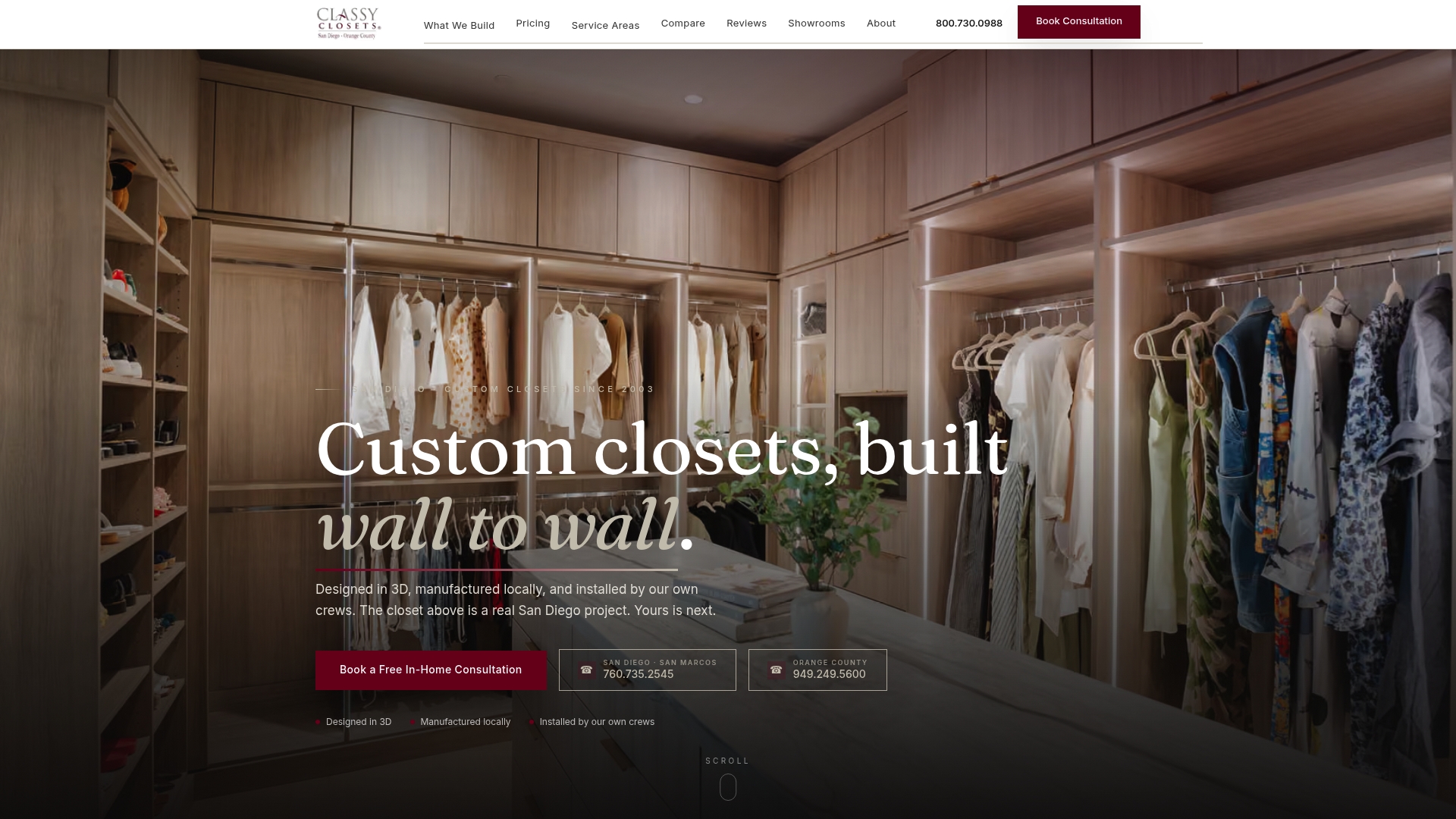
To see what we have built, browse the San Diego closets gallery, or contact us to book your consultation.
FAQ
How do I organize a very small nursery closet?
Start with a second rod below the first, since baby clothes are short and the space underneath is wasted. Then add a deeper top shelf, hooks on the side walls and an over-the-door organizer. In a reach-in closet, a fitted system makes use of every inch, which off-the-shelf parts cannot do.
Do I need a dresser in the nursery if I have a closet?
Not necessarily. Built-in drawers inside the closet do the same job and free up bedroom floor space. If you do use a freestanding dresser, anchor it per the manufacturer’s instructions and keep cords and hanging items away from the crib.
How high should the rods go in a nursery closet?
A common double-hang setup puts the upper rod at about 80 inches and the lower rod at about 40 inches from the floor. This Old House suggests the lower rod roughly 3 feet up for short garments, and both rods at least a foot from the back wall. Our rod height guide covers the details.
Can the closet double as a changing station?
Yes. Put a changing pad on a drawer unit inside the closet, with diapers and wipes in the drawers beneath it and hanging clothes beside it. Plan a light and a comfortable counter height. It saves bedroom space and keeps everything within arm’s reach.
How do I keep a nursery closet from becoming outdated in a year?
Choose adjustable shelves, movable rods and drawers that can be added or removed. That way the baby closet becomes a toddler closet and then a kid’s closet without replacing the whole thing. Keep a donation bin in the closet so outgrown sizes leave regularly.
Sources
- Nursery Closet Organization Ideas | HGTV
- How To Build Nursery Closet Shelving in Your Home | This Old House
- Organize a Nursery: the 7-Step Simple Plan | Bark and Chase
- How to Organize a Small Nursery | Public Storage
- How to Organize a Nursery Closet: A System That Grows | The Practical Nursery
- Nursery Closet Organization Ideas | Happiest Baby
- 25 Nursery Storage Ideas to Organize Clutter in Style | The Spruce
- 3D Product Rendering for Closet Systems and Organizers


