


The best corner closet solutions combine custom built-ins or pull-out carousels for blind corners, bridge and angled shelving for visible angles, targeted lighting, and labeled bins for everyday order. Choose DIY fixes like floating shelves and stackable bins for a weekend project under $200, and bring in a custom installer when the corner is irregular, load-bearing, or part of a full closet remodel. The sections below break down each option by cost, fit, and effort.
TL;DR:
- Before buying a pivot unit or carousel, measure the door swing radius and hardware footprint; rotating storage needs clearance, while seasonal boxes suit fixed shelves.
- Floating shelves need hidden brackets rated for at least 20 pounds per shelf; bracket strength matters more than choosing an expensive board.
- Keep daily clothes and shoes around shoulder to hip height, place monthly items higher or lower, and reserve the deepest shelves for seasonal storage.
- Choose a custom installer for irregular angles, structural obstructions, or integrated lighting; request an itemized quote, installation timeline, and workmanship warranty before signing.
Table of Contents
- Top corner closet solutions ranked by practicality
- Custom built-ins and modular systems for corners
- Pull-out carousels, pivot units and blind-corner mechanisms
- Corner shelving, bridge shelves and angled-shelf approaches
- Lighting and visibility upgrades for corners
- Organization, reach zones, and ergonomic placement
- When to choose a custom installer
- Organizational accessories that fit corner closet setups
- A simple way to decide between DIY and custom
- Let Classy Closets design your corner the right way
- FAQ
- Sources
Top corner closet solutions ranked by practicality
Corners waste more closet space than any other zone because standard rods and shelves stop short of the angle. These ideas, ranked roughly from cheapest to most involved, help you match a fix to your closet type and budget.
- Floating corner shelves: Mount two or three shelves at an angle to catch the dead space above eye level; renter-friendly with removable adhesive brackets.
- Angled shelf cuts: A single shelf cut to follow the corner’s diagonal line, good for closets with an awkward 45-degree cut-in.
- Bridge shelves: One shelf spanning both walls of the corner, creating a display ledge or extra fold space.
- Pull-out wire baskets: Slide-out baskets tucked into the blind zone, ideal for folded items you grab often.
- Blind shelf storage: Fixed shelving pushed deep into the corner for seasonal bins you access twice a year.
- Mirror placement: A corner-mounted mirror doubles as a dressing spot and visually opens a tight closet.
- Boutique-style racks: A rounded or diagonal rack that follows the corner curve, common in walk-in retrofits.
- Double-hung rods: Stack two rods on the straight wall next to the corner to free the angle for shelving.
- Stackable bins: Modular plastic or fabric bins that climb the corner vertically, a renter-friendly fix.
- Lazy Susan-style carousel: A rotating platform for shoes or accessories that solves retrieval without reaching into the void.
- Over-the-door hooks near the corner: Catches scarves, bags, or belts without taking floor space.
- Corner-specific shoe cubbies: Angled cubby inserts sized to the diagonal, often sold as flat-pack kits.
Most of these cost less than a few hundred dollars and can be installed in an afternoon. The ones that need tools, a level, and some patience are marked above; everything else is a drill-and-done project.
Custom built-ins and modular systems for corners
A blind corner, the triangular gap where two rods or shelf runs meet, is the hardest part of any closet to use well. Custom built-ins solve it by wrapping shelving, drawers, and hanging space around the actual angle instead of stopping short of it. Modular systems do something similar with pre-engineered panels that adjust as your storage needs change.
Peer-reviewed modular wardrobe evaluation ranked corner-space utilization, adjustability, and ease of clothing access as the top priorities for compact living, ahead of raw shelf count or finish quality. The same research found that reconfigurable, modular wardrobes scored higher than fixed structures for users whose storage needs shift over time, which is most households within a few years.
That tells you something practical:
- A system that lets you move shelves and rods later outperforms a fixed layout, even a nicer-looking one.
- Modular hardware reduces wasted material and damage during install compared to custom-cut-only builds.
- Internal zoning (separating hanging, folded, and bin storage) matters more than maximizing total shelf area.
Pro Tip: If you’re unsure whether to go custom or modular off-the-shelf, measure your corner’s actual usable depth first. A shallow corner rarely justifies a full custom build.
Pull-out carousels, pivot units and blind-corner mechanisms
Mechanical corner solutions exist specifically for the dead triangle behind a standard rod. The right pick depends on clearance and what you’re storing.
- Single pivot units swing out on a hinge and work well in narrower closets with limited door swing.
- Double carousels rotate on a center post and hold more volume, but they need extra depth to spin freely.
- Bi-fold pull-outs fold flat against the wall when not in use, a good fit for closets with tight walking space.
Before ordering any of these, measure the door swing radius and the mechanism’s hardware footprint, not just the shelf depth. Shoes and bags do well on carousels since retrieval is one motion; seasonal items are better left on fixed blind shelves where you’re not fighting a rotating platform for a box you open twice a year. For more shoe-specific layouts, see our shoe storage ideas.
Corner shelving, bridge shelves and angled-shelf approaches
Fixed shelving is the cheapest way to make a corner functional, and it looks intentional rather than improvised when done well.
- Floating corner shelves work for display items and folded stacks; use solid wood or a ¾-inch plywood with hidden brackets rated for at least 20 pounds per shelf.
- Bridge shelves span the angle itself, turning a wasted corner into one continuous surface for bins or boxes.
- Staggered shelving climbs the corner in offset rows, good for vertical display of shoes or folded sweaters.
Mix open shelving for items you want visible with a concealed bin or basket on the lowest shelf for anything you’d rather not see daily. Brackets matter more than the shelf material: a cheap board on a solid bracket outlasts a nice board on a weak one.
Lighting and visibility upgrades for corners
Corners are the darkest part of most closets because they sit farthest from the door and any overhead fixture. A few lighting fixes change that without an electrician.
- LED strips run along the underside of bridge shelves or floating shelves, lighting the exact zone you’re reaching into.
- Puck lights work for spot lighting on a single shelf or cubby and mount with adhesive pads.
- Motion-sensor lights turn on automatically, useful in a corner you can’t see well enough to find a switch.
Battery-powered versions suit renters since they skip any wiring or permanent fixture. For a wider range of LED and ambient lighting options, The Media Wall Store’s lighting line covers strip and accent lighting that adapts well to shelf installs.
Organization, reach zones, and ergonomic placement
Where you put things in a corner matters as much as what fixture holds them. Ergonomic research on shelf and container placement shows that storage height and position affect retrieval effort and physical strain, and shelving built around clear reach zones reduces that effort.
A simple three-zone rule works for most corner closets:
- Frequent zone (roughly shoulder to hip height): daily-wear clothes, everyday shoes, and the basket you grab every morning.
- Occasional zone (overhead or lower shelves): bulkier items like handbags, belts, or off-season layers you touch monthly.
- Seasonal zone (deepest blind-corner shelves or top shelf): holiday items, luggage, or clothes stored for months at a time.
The ergonomic studies behind shelf-layout tools show that rearranging frequently picked items into easier-reach positions measurably lowers physical strain, which is the same logic behind putting daily items at mid-reach and seasonal boxes in the deepest, hardest-to-reach corner. Label bins by category, use dividers to keep folded stacks from toppling, and keep the frequent zone clear of anything you only need twice a year.
When to choose a custom installer
DIY fixes handle most corners, but some situations call for a professional measure-and-build job instead of an off-the-shelf kit.
- The corner has an irregular angle, a slanted ceiling, or a structural obstruction that standard shelving can’t follow.
- You want integrated lighting built into the shelving rather than stuck-on strips.
- The closet gets heavy daily use and needs a layout engineered for specific items, not generic bins.
A professional installer typically delivers a 3D design built around your exact measurements, an itemized quote so you know what each component costs, and installation by a dedicated crew rather than a subcontractor. Look for a workmanship warranty, a clear installation timeline, and photos of completed, similar jobs before signing anything.
Pro Tip: Ask for the itemized quote before the design is finalized. It’s the fastest way to tell a transparent installer from one padding the total.
Organizational accessories that fit corner closet setups
Fixtures solve the structural problem; accessories keep the corner usable week to week. A few additions make the biggest difference in a tight angle.
Fabric or wire baskets with labels keep loose items grouped by category instead of sliding into a pile at the back of the shelf. Clear bins work well in blind-corner storage since you can identify contents without pulling the bin out, which matters when the corner is hard to reach. Stackable drawer organizers subdivide a single shelf into smaller compartments for folded items, socks, or accessories that would otherwise slump sideways.

Over-the-rod hooks and tension rods add vertical hanging space without new hardware, useful for scarves or bags near the corner’s edge. Drawer dividers inside any pull-out basket keep smaller items from migrating to one side every time the basket slides. For closets with a mix of hanging and folded storage, a rod-and-shelf combination unit lets you zone the corner into hanging on one side and bins on the other without a full rebuild.
None of these require tools beyond a tape measure, and most cost under $40 each. The goal is matching the accessory to the reach zone it serves: labeled bins up top for seasonal items, open baskets at mid-height for daily grabs.
A simple way to decide between DIY and custom
Pick DIY for speed and low cost on a standard-shaped corner; pick custom when the angle is irregular or the closet needs to last through years of heavy use. Either way, measure the corner before you order or build anything.
— Gary Pavitt
Let Classy Closets design your corner the right way
When a corner closet needs more than a shelf and a basket, we design it around your exact angle, not a generic template. Every project starts with a free in-home 3D design consultation, moves to an itemized quote so you see what each piece costs, and finishes with installation by a dedicated crew, backed by a workmanship warranty.
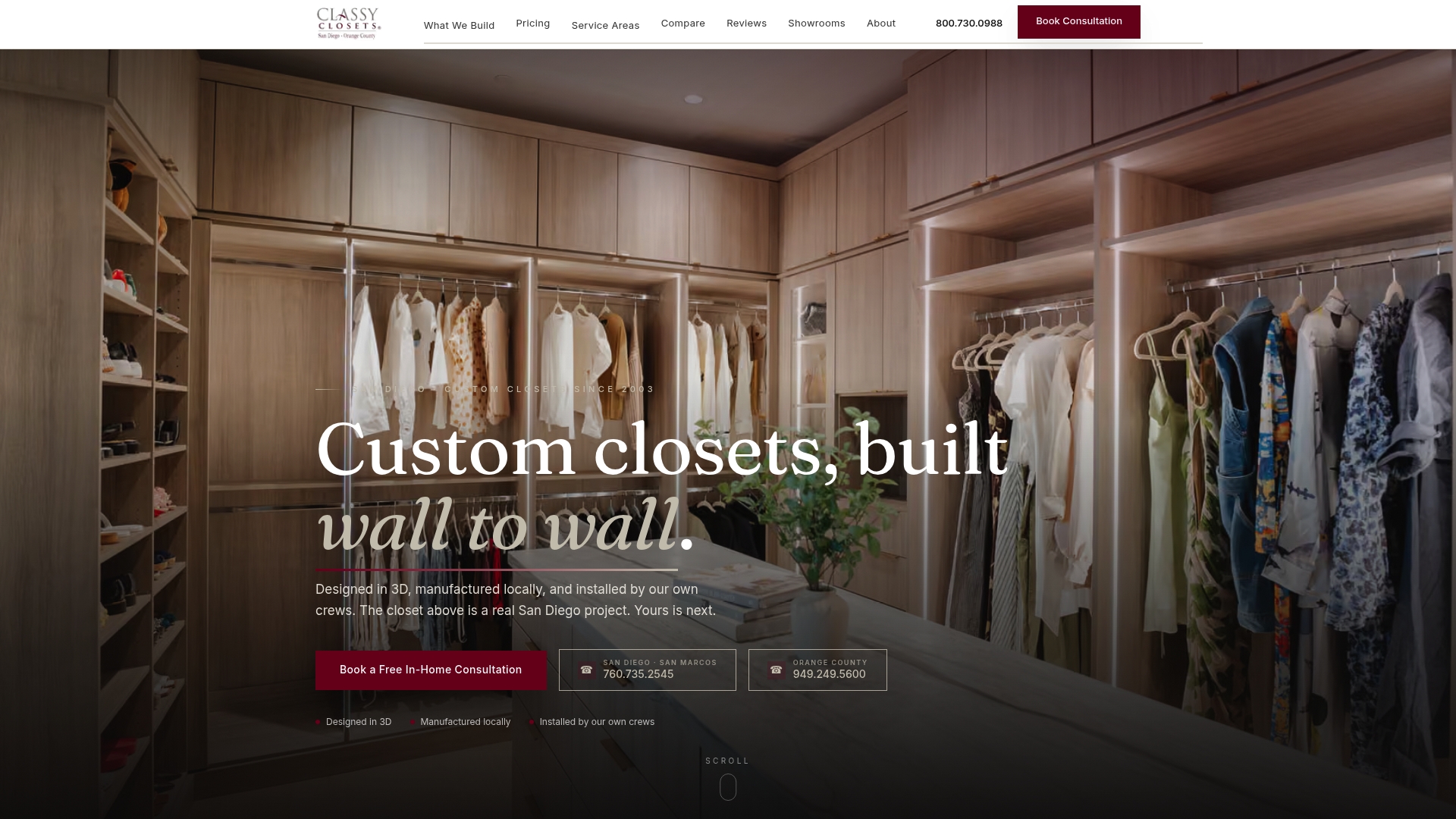
Before your consult, measure the corner’s depth and height and note anything you want hidden versus displayed. From there, we build a layout manufactured locally to fit. Start with our custom closet services to see what a corner-specific design looks like for your space.
FAQ
How to make closet corners useful?
Fit the corner with a mechanism or shelf built for an angle, such as a bridge shelf, pull-out basket, or pivot carousel, rather than leaving the standard rod to stop short of it. Add lighting under any shelf that sits in shadow, and assign the deepest part of the corner to seasonal items you rarely need.
What can I use instead of a closet?
Open shelving units, wardrobe armoires, or wall-mounted hanging rods can substitute for a built closet in a room without one. Corner-specific versions of these, like a corner wardrobe or a diagonal shelving unit, apply the same space-saving logic to a room’s unused angle.
Is a corner closet a good idea?
A corner closet makes sense when it’s designed around the angle rather than fitted with standard straight shelving, since modular wardrobe research found that corner-space utilization and adjustability rank among the top priorities for compact living. Done well, it reclaims space that a standard layout wastes.
What is the cheapest DIY closet system I can build?
Floating corner shelves paired with stackable bins form the cheapest effective setup, often under a few hundred dollars using basic brackets and plywood. Battery-powered LED strips add visibility for a few dollars more without any wiring, and both options fit a rented space without permanent changes.
When should I hire a custom installer instead of a DIY kit?
Hire a custom installer when the corner has an irregular angle, a structural obstruction, or needs integrated lighting that a flat-pack kit can’t handle. A professional job typically includes a 3D design, an itemized quote, and a workmanship warranty, which is worth the cost for a closet you’ll use daily for years.
Sources
- Modular wardrobe design: IPA-CRITIC-TOPSIS evaluation
- A CAD-Based Tool to Support the Configuration of Parts Storage Shelving in Assembly Workstations


