


A built-in laundry hamper is a hamper, usually a removable basket or bag, housed inside a cabinet, drawer or closet so dirty clothes stay out of sight and close to where you take them off or wash them. The best versions are measured to the space they live in, which is why a custom-built hamper cabinet tends to outperform a stock insert in an odd-sized closet, laundry room or bathroom. Below you will find the designs that work, how to size them, what hardware to look for, and how the same thinking applies to pull-out pantry shelves and jewelry drawers.
In San Diego County, where many homes have compact laundry closets, shared bedroom closets and tight garages, we design these pieces in 3D, build them locally and install them with our own crew. Our laundry room cabinets are one place a built-in hamper naturally belongs.
TL;DR
- Tilt-out, pull-out and drawer-style hampers each suit a different space: tilt-outs fit slim cabinets, pull-outs fit standard cabinet openings, drawers fit closets.
- Choose the style by where laundry actually travels in your home, not by what looks neatest in a photo.
- Full-extension, load-rated slides and removable baskets matter more than the finish.
- Pull-out pantry shelves and jewelry drawer inserts follow the same rule: measure the opening first, then pick the hardware.
- A custom build is cut to your exact dimensions, with itemized pricing and a 10-year workmanship warranty from us.
Table of Contents
- Why a built-in hamper beats a freestanding basket
- Built-in hamper designs that work
- Where a hamper belongs: closet, laundry room, mudroom or bathroom
- Sizing a hamper and choosing hardware
- The same logic for pull-out pantry shelves
- Jewelry drawer organizers and jewelry storage in a closet
- Why a custom build suits this job
- Get a hamper built into your space
- Our point of view
- FAQ
- Sources
Why a built-in hamper beats a freestanding basket
A freestanding basket is cheap, but it takes up floor area in exactly the rooms where floor area is scarce. It also looks like clutter the moment it overflows. A built-in hamper moves that volume into cabinet space you were already paying for, and it closes behind a door or drawer front.
There are three practical gains:
- Floor space. Bedroom and bathroom floors stay clear, which matters in a closet where you are already stepping around shoes.
- A fixed home for laundry. When everyone knows where dirty clothes go, sorting gets easier. Families with kids often split a double hamper into darks and lights, or into “wash” and “hand wash.”
- A cleaner look. Doors, drawer fronts and matching finishes make the hamper part of the room instead of an add-on.
The tradeoff to plan for is the laundry route. A hamper is only convenient if it sits where you actually undress or where you load the washer. The next sections cover both.
Built-in hamper designs that work
Design roundups from Houzz show the range: tilt-out hampers with wire baskets, pullout hampers, slim cabinets tucked between machines, full-extension basket drawers, rolling hampers under counters, and recessed alcoves. Here is how those translate into choices for a San Diego home.
| Design | Best for | What to know |
|---|---|---|
| Tilt-out hamper cabinet | Bathrooms, narrow wall sections, bedroom closets | The front swings down on a hinge and the basket or bag sits behind it. Compact, but you lift laundry up and out. |
| Pull-out hamper | Standard base cabinets in laundry rooms and bathrooms | A frame on slides rolls forward. Good capacity and easy two-bin sorting. |
| Basket drawer | Walk-in and reach-in closets, built-in dressers | Drawer boxes with full-extension slides. Fits into a closet tower and matches the rest of the system. |
| Slim cabinet between machines | Laundry rooms with a few inches to spare | Uses the gap beside a washer, and the door swing can be set to match where you load. |
| Under-counter rolling hamper | Laundry rooms with a folding counter | Portable baskets roll out and can be carried to the washer. |
| Recessed alcove or open shelf with baskets | Mudrooms, hallways, small closets | Simple and flexible, with the least hidden hardware. |
Tilt-out hampers
A tilt-out hamper is the classic bathroom and bedroom solution. Because the door is the front of the hamper, it looks like an ordinary cabinet. It works well when the space is too narrow for a pull-out, but a tall, heavy load can be awkward to lift out, so removable liners with handles are worth specifying.

Pull-out hampers
A pull-out hamper sits on slides and glides forward, so you drop clothes in from above. Double-bin versions split loads before they reach the machine. This is usually the most comfortable style for adults because nothing has to be lifted over a lip.
Basket drawers in the closet
In a closet, a hamper drawer can be built right into the system, below hanging rods or inside a tower of drawers. The finish, handles and drawer fronts match the shelves around it, which is the main reason people choose this over a freestanding bin.

Where a hamper belongs: closet, laundry room, mudroom or bathroom
Houzz notes that hamper systems work better when the laundry room is on the same floor as the bedrooms or the home has a laundry chute, while portable baskets suit homes where laundry must be carried to another floor. That is the single most useful planning test.
- Laundry on the bedroom level. Built-in hampers in each bedroom closet or the hall make sense, and a wash-day trip is short.
- Laundry downstairs or in the garage. Keep a hamper where clothes come off, but choose removable baskets so a full load can be carried. Many San Diego homes with garage laundry fall into this group.
- Condo or apartment with a laundry closet. A slim cabinet beside the washer and dryer, or a hamper drawer in the nearest closet, saves the most space.
- Mudroom or entry. Open baskets in an alcove handle towels and sports gear well, especially for surf and beach families.
Think about the door swing too. Houzz shows a hamper placed to the left of a washer with its door opening on the left so transfer to the machine is easy. If your washer door opens one way, the hamper door should help, not block.
Lighting also changes how a laundry room feels to use. A guide to laundry room lighting is a good place to think about where hamper, counter and machines will be lit before cabinets are finalized.
Sizing a hamper and choosing hardware
Most frustration with built-in hampers comes from three things: a basket too small for a week of laundry, slides that sag, or an opening that does not match the hardware. A few rules keep you out of that trouble.
Measure the opening, not the catalog
Measure the cabinet width, depth and height at the narrowest point, and subtract for the face frame or door hinges. Pull-out hardware is made for specific opening widths, so a stock unit can leave gaps or simply not fit in an older bathroom or closet. This is where custom work pays off: the cabinet is built around the hamper, not the other way round.
Slides decide how long it lasts
A full basket of wet towels is heavy. Family Handyman explains that roller slides are typically rated 35 to 100 pounds and extend about three quarters of their length, while ball-bearing slides are typically rated 75 to 100 pounds, with 200-pound versions available, and extend fully. For a hamper you want full extension so you can reach the back of the basket, and a rating well above the load you expect.

Removable baskets and ventilation
Choose baskets or bags that lift out, so you can carry them to the washer. Slots, perforations or breathable fabric help damp items air out, which keeps the cabinet from smelling stale, a real consideration in humid bathrooms.
Capacity
Think in laundry loads. One adult generates about a basket of clothes a week, a couple roughly twice that, and a family with kids more still. Two bins, one per sorting category, usually beat one large bin. If your cabinet cannot hold that, move the hamper to a drawer in the closet and keep the cabinet for supplies.
The same logic for pull-out pantry shelves
People searching for pull-out and roll-out pantry shelves are solving the same problem as hamper shoppers: stuff trapped at the back of a deep cabinet. A few details are worth knowing before you choose.
- Width. Family Handyman cites kitchen designer Mary Jane Pappas as typically recommending rollout widths of 18 to 30 inches: larger is clumsy, smaller wastes too much space on the hardware. For cabinets wider than 30 inches, consider two narrower rollouts.
- Narrow gaps. The same article notes that pull-out shelves can put a filler space only 3 to 6 inches wide to work.
- Depth and spacing. This Old House suggests bottom shelves 16 to 18 inches deep spaced 18 to 24 inches apart for bulky items, and eye-level shelves 12 to 14 inches deep, spaced 14 to 16 inches apart, for cereal boxes and canisters. Spice and can shelves should be no more than 6 inches front to back.
- Climate. The same guide advises keeping a pantry cool and dry, ideally below 70 degrees Fahrenheit and 45 percent humidity, so avoid putting a pantry against a hot exterior wall.
Installation is precise work. A manufacturer’s installation sheet for one pantry pull-out lists a 60 to 90 minute install: pilot holes from a bottom slide template, eight screws into the cabinet floor, a top slide mounted flush with the face frame, and a door overlay calculated as the door width minus the opening width, divided by two. Small mistakes in any of those throw the door out of alignment. A custom pantry avoids many of them because the cabinet and the pull-outs are drawn together. Our pantry storage is designed the same way as our closets.
For a rough sense of hardware-only prices, Bob Vila reported in 2023 that a 6-by-24-inch pullout shelf costs $40 to $50 and custom tall or double-set pullouts $80 to $110. Those are component prices; a built pantry is priced as a full system.
Jewelry drawer organizers and jewelry storage in a closet
Jewelry storage is the other small-scale built-in that people pair with hampers in a closet or dressing area. The principle is to size each compartment to the piece it holds and keep the shallow drawer where you get dressed.
- Necklaces need flat runs or hooks so chains do not tangle.
- Earrings and rings do best in small cells or wells, one item or pair per cell.
- Bracelets and watches want open, padded sections.
- Layout. IKEA’s product page for its pull-out tray with a jewelry insert advises placing the larger compartments toward the back so everything stays easy to reach.
Measure the drawer’s interior at the bottom, not the top, and keep it shallow so you see everything at once. A drawer built into a closet island or tower can be sized to the exact compartments you need. Add a felt or soft liner, and keep a slim drawer at hand height, not down by your knees.
Why a custom build suits this job
Stock hampers, pull-outs and inserts work when the space is standard. San Diego homes often are not: remodeled bathrooms with odd cabinet widths, closets under sloped ceilings, laundry closets squeezed between walls. When a gap is 17 and a half inches wide, a stock unit leaves a sliver of wasted space or does not fit at all.
A custom system solves that in three ways:
- It is drawn to your measurements. We design in 3D, so you see the hamper, drawers and door swing before anything is cut.
- It is made locally. Our pieces are manufactured in San Diego, not shipped from far away.
- One crew from start to finish. We use our own installation crew, so the person who knows the drawing is the person on site.
Pricing is itemized, so you can see what the hamper, slides, drawers and doors each add before you sign.
Get a hamper built into your space
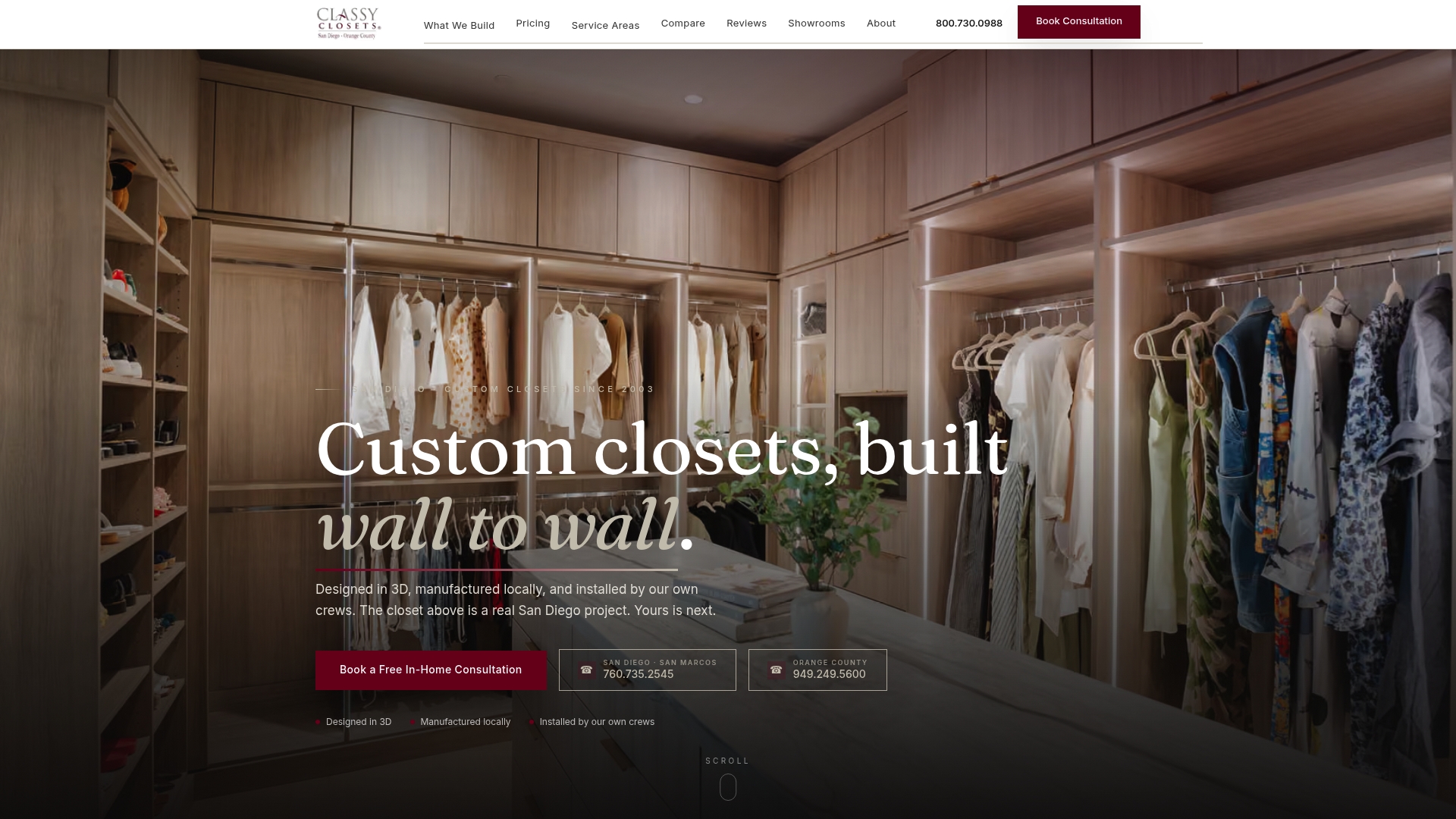
If you want a hamper in a closet, a laundry room or both, start with our free in-home 3D design consultation. We measure the space, talk through how laundry moves through your home, and show you the design in 3D. Every project comes with a 10-year workmanship warranty and itemized pricing.
For scale, our Reach-In System starts from $700 and our Custom Closet starts from $3,000. Laundry room cabinets are quoted to the room. See our laundry room cabinets, browse the closet gallery, or contact us for a visit in San Diego or Orange County.
Our point of view
We have a simple view of hampers: they should disappear into the room and still be the easiest thing in it to use. That only happens when the hamper is designed together with the closet or cabinet around it, not added afterwards.
Most of the frustration we hear about comes from space that does not match the product. A bin that is almost the right size leaves a gap that collects dust, and a stock drawer that is almost the right width rubs on the frame. So we start with exact dimensions and draw everything in 3D, so you can see how the door swings and how far the drawer pulls out before it is built.
We build locally and install with our own crew because the details decide whether a hamper drawer glides for ten years. Our 10-year workmanship warranty reflects that. And we publish itemized pricing because you should know what each piece costs before you decide, whether you are adding one hamper drawer to a closet or planning a full laundry room.
Gary Pavitt
FAQ
Where is the best place for a built-in laundry hamper?
Put it where clothes come off and, if possible, on the same floor as your washer. If laundry is carried between floors, choose removable baskets so you can transport a full load. A bedroom closet drawer or a bathroom cabinet is usually the most convenient spot.
Is a tilt-out or pull-out hamper better?
Tilt-outs fit narrow cabinets and look like an ordinary door. Pull-outs hold more, slide forward so you drop clothes in from above, and suit double-bin sorting. If you have the width, a pull-out is usually easier to live with every day.
What slides should a hamper use?
Choose full-extension slides rated comfortably above the weight of a full load. Family Handyman notes that ball-bearing slides are typically rated 75 to 100 pounds and extend fully, which suits a heavy hamper better than lighter roller slides.
Can a hamper be added to an existing closet?
Yes. A hamper drawer or pull-out can be built into a reach-in or walk-in closet system and matched to the shelves and doors around it. We measure the closet in your free consultation and show the design in 3D first.
Do you build pull-out pantry shelves and jewelry drawers too?
We build custom pantry storage and closet systems, so pull-out shelving and shallow drawers for accessories can be designed into the same plan. Bring a list of what you store and we will size the compartments to it.
Sources
- Houzz: The Hardworking Laundry, Make Room for Hampers and Baskets
- Family Handyman: 10 Tips for Installing Pull Out Pantry Shelves
- This Old House: Read This Before You Put In a Pantry
- Pantry pull-out installation sheet (60-90 minute install)
- Bob Vila: Cost to Install Pullout Shelves in Kitchen Cabinets
- IKEA: KOMPLEMENT pull-out tray with insert


