


Elfa is the better long-term system for a primary walk-in closet with heavy daily use, and ClosetMaid is the better buy for a guest closet or a budget renovation. Elfa costs several times more, but it adjusts more freely and its parts tend to last longer. If neither fits your closet’s odd angles, sloped ceilings or tight budget for wasted space, a custom build is the third path, and we cover when it makes sense below.
TL;DR
- Price: ClosetMaid is the cheapest system in the category. Elfa Classic is the most expensive by a wide margin, and installation is extra.
- Flexibility: Elfa’s top track lets you slide vertical standards along its length. ClosetMaid standards are fixed at stud spacing.
- Materials: Elfa uses aluminum extrusions and steel components. ClosetMaid uses powder-coated steel wire or laminate-covered particleboard.
- Best fit: Elfa for a primary walk-in with heavy loads. ClosetMaid for guest rooms, rentals and quick refreshes.
- Before you buy: Measure, inventory your clothes and check weight ratings per linear foot.
Table of Contents
- Elfa vs ClosetMaid at a glance
- How the two systems are built
- What each one costs
- Installation and reconfiguring later
- Durability, weight limits and warranty
- Which closets suit which system
- Measure and plan before you buy
- When neither kit fits: the custom option
- Get a custom quote in San Diego
- How to decide in five minutes
- FAQ
- Sources
Elfa vs ClosetMaid at a glance
The two systems solve the same problem in different ways. Both hang from a wall-mounted track, and both let you move shelves up and down. The differences show up in how the track is anchored, what the parts are made of, and what you pay.
| Factor | Elfa | ClosetMaid |
|---|---|---|
| Typical price tier | Highest in the category | Lowest in the category (ShelfTrack) |
| Main materials | Aluminum extrusions, steel and wire components | Powder-coated steel wire, or laminate over particleboard |
| Standards (verticals) | Slide anywhere along the top track | Fixed at stud spacing |
| Installation | Fewer wall holes, easier to rearrange | More anchor points, harder to take down |
| Warranty (per one comparison) | Limited lifetime | 10-year limited |
| Best for | Primary walk-ins, heavy daily use | Guest closets, budget renovations |
The rest of this guide explains each row so you can decide with real numbers.
How the two systems are built
Elfa: a top track with movable standards
Elfa starts with a horizontal track fastened near the top of the wall. Vertical standards hook into that track, and brackets clip into the standards. Because the standards can be positioned anywhere across the top track, you can shift a section a few inches left or right without drilling new holes. That matters in closets where studs do not fall where you want a shelf to land.
The same comparison notes that Elfa’s top-track design does not strictly require a stud behind every vertical standard to function. Anchoring to studs still raises load capacity, so for a heavy hanging section it is worth finding them.
For materials, Elfa uses aluminum extrusions in its structure, with a more finished look than bare wire. Drawers, baskets and shelves are available in matching components, which is why Elfa often looks like a built-in from the doorway.
ClosetMaid: wire and laminate lines
ClosetMaid sells several lines. The best known is ShelfTrack, a wire-shelf system with a hang track and vertical standards. A second family, including laminate lines such as SuiteSymphony, uses wood-look panels. Powder-coated steel wire or particleboard laminate are the core materials.
The key structural difference is that ShelfTrack’s standards are fixed at stud spacing. The hang track needs screw-in points into studs, so your layout is partly decided by where the framing is. Shelves still adjust vertically, which covers most needs in a standard reach-in.
One trade-off of open wire is worth planning around. Metal shelves promote air circulation, but smaller items can fall through and the look is less refined. A liner or a drawer unit solves most of it.
What each one costs
Price is where the two systems separate most. Published figures vary by retailer and year, so treat the numbers below as ranges for planning, not quotes.
- 8-foot walk-in with two hanging rods, two shelves and a drawer bank: one comparison puts Elfa at $1,200 to $1,800, plus $300 to $500 for installation, and ClosetMaid at $400 to $700 for the same configuration.
- 72-inch reach-in: a consumer testing organization found a wire Elfa Classic system started at $1,109, while ClosetMaid wire kits ran $85 at one big-box store and $136 at another.
- Installation: Elfa installation is extra and usually runs about one-third of the system cost. One big-box chain offers third-party installation with job-based fees, and another does not install at all.
Overall, ClosetMaid ShelfTrack is the lowest-priced system in the category and Elfa Classic the highest by a wide margin. Three things move the total: the materials you pick, how complex the layout is (corners, sloped ceilings, many drawers), and whether you hire the work out.
The hidden cost of a cheap kit
A $85 kit covers a hanging rod and a shelf. It rarely covers drawers, shoe storage, a finished look or a layout built around your actual wardrobe. Most people end up buying add-ons, so price the full closet you want, not the starter kit on the shelf.
Installation and reconfiguring later
If you plan to install yourself, the difference is noticeable. A hardware-store review found that Elfa is easier to install and needs fewer wall holes. ClosetMaid is more tedious to put up and takes more effort to take down when you rearrange, while Elfa components stay sturdy when moved.
That matters if your needs change. A family that goes from a toddler’s closet to a teenager’s closet in six years will move rods and shelves more than once. Every extra anchor hole is patching and repainting later.
A few practical points for either system:
- Find the studs first and mark them on the wall.
- Level the top track or hang track before loading anything. A track that is a quarter inch off shows in every shelf.
- Use the anchors that come with the system only for the wall type it was designed for. Plaster, drywall over masonry and metal studs each need their own hardware.
- Do not over-torque Elfa bracket tabs. One comparison warns they can snap if over-tightened.
Durability, weight limits and warranty
Both systems are durable in normal use. The House Digest review says both hold up, Elfa components tend to last longer, and ClosetMaid is better for people on a budget.
Check the load ratings
Whichever you pick, compare numbers rather than marketing. A closet-systems guide recommends checking that clothing shelves support at least 30 to 40 pounds per linear foot, hanging rods 30-plus pounds per foot, and utility shelves at least 50 pounds per shelf. A shelf of denim, a row of coats or a stack of shoe boxes gets heavy fast.

Wear points
Each system has a weak spot to plan for. Elfa drawer slides may wear after roughly 20,000 cycles, which one comparison translates to about 5 to 7 years of daily use. ClosetMaid wire coating may peel in humid areas, and laminate shelf edges may swell with moisture. If your closet sits against an exterior wall, near a bathroom or in a coastal home, keep it dry and ventilated. A good odor control approach for closets also helps with the musty smell that damp closets develop.
Warranty
The same comparison lists Elfa with a limited lifetime warranty and ClosetMaid with a 10-year limited warranty. Read the terms before you buy, because limited warranties usually cover parts and not labor or wall damage.
Which closets suit which system
Both work in walk-in and reach-in closets. The pattern from reviewers is consistent:
- Primary walk-in with heavy daily use: Elfa. One designer’s assessment calls it the better investment for primary walk-ins where durability matters.
- Guest room or rental: ClosetMaid. It is adequate for budget renovations and closets that see light use.
- Kids’ rooms: either, but pick adjustability. Rods and shelves will move several times as children grow, so look for a system that rehangs without new holes.
- Mid-range look: a roundup from a retail research site notes that Elfa is often the choice for maximum flexibility, while ClosetMaid’s wood-look laminate lines are popular mid-range options.
- Home office or garage: shelving systems work for supplies, but built-in cabinets handle desks, doors and heavy tools better.
Measure and plan before you buy
Most regrets come from skipping the plan. Before you compare prices, do three things.
- Measure the space. Wall length, ceiling height, door width and any obstructions such as vents or sloped sections.
- Inventory what you own. Organizer Julie Morgenstern advises counting your belongings to find your real spacing needs, with a mix of drawers for small items and shelves for folded garments.
- Convert items to space. Estimate shelf space from stacks of folded items, and hanging space from the linear feet your clothes occupy, with a little extra room so garments can breathe.
If you store more than clothes, the plan changes. A closet that also holds a firearm or valuables needs locked storage designed in from the start, and this gun closet storage setup guide walks through taking inventory and measuring before you choose anything.
For a deeper starting point, see our guide to where to start with closet organization, and our small closet organization fixes if space is the main limit.
When neither kit fits: the custom option
Elfa and ClosetMaid are modular. That is their strength and their limit. They come in standard widths and depths, and your closet may not be standard: a sloped ceiling under a stairway, a 7-foot-4-inch wall, a corner that eats a section, or a reach-in with an awkward door.

In those cases a custom closet uses every inch, and it is often the better choice for a couple sharing one closet or a family who wants the room to last for a decade. A custom build is measured on site, designed in 3D so you see it before it is made, and fitted to the walls as they actually are.
Price context matters, and here is ours. At Classy Closets our published starting points are from $700 for a reach-in system, from $3,000 for a custom closet and from $3,000 for a walk-in closet design. Those are starting prices, and the final number depends on size, materials and options. Our quotes are itemized, so you can see what each part costs.
Our view: design for the closet you have
We build closets in San Diego every week, and the pattern is the same. People start with a kit because the price looks easy, then spend the next few years working around a layout that was never made for their room. The wasted space is not in the kit. It is in the gaps at the ends, above the top shelf and in the corners.
That is why we design every project in 3D from exact measurements, manufacture it locally and install it with our own crew. Nothing is subcontracted, so the person who measured your closet and the people who build it work the same way every time. Our work carries a 10-year workmanship warranty.
If you love the look of a modular system and your closet is a clean rectangle, a kit can serve you well. If your closet has quirks, or you want drawers, doors, lighting and a finish that looks built in, we think custom is the better investment per square foot of usable storage. Ask us for an itemized quote and compare it line by line with the kit you were considering.
Gary Pavitt
Get a custom quote in San Diego
If you are comparing kits because you want organized storage that fits your home, we can design it for you. We offer free in-home consultations with a 3D design, and the price is itemized, so you know what you are paying for before you commit.
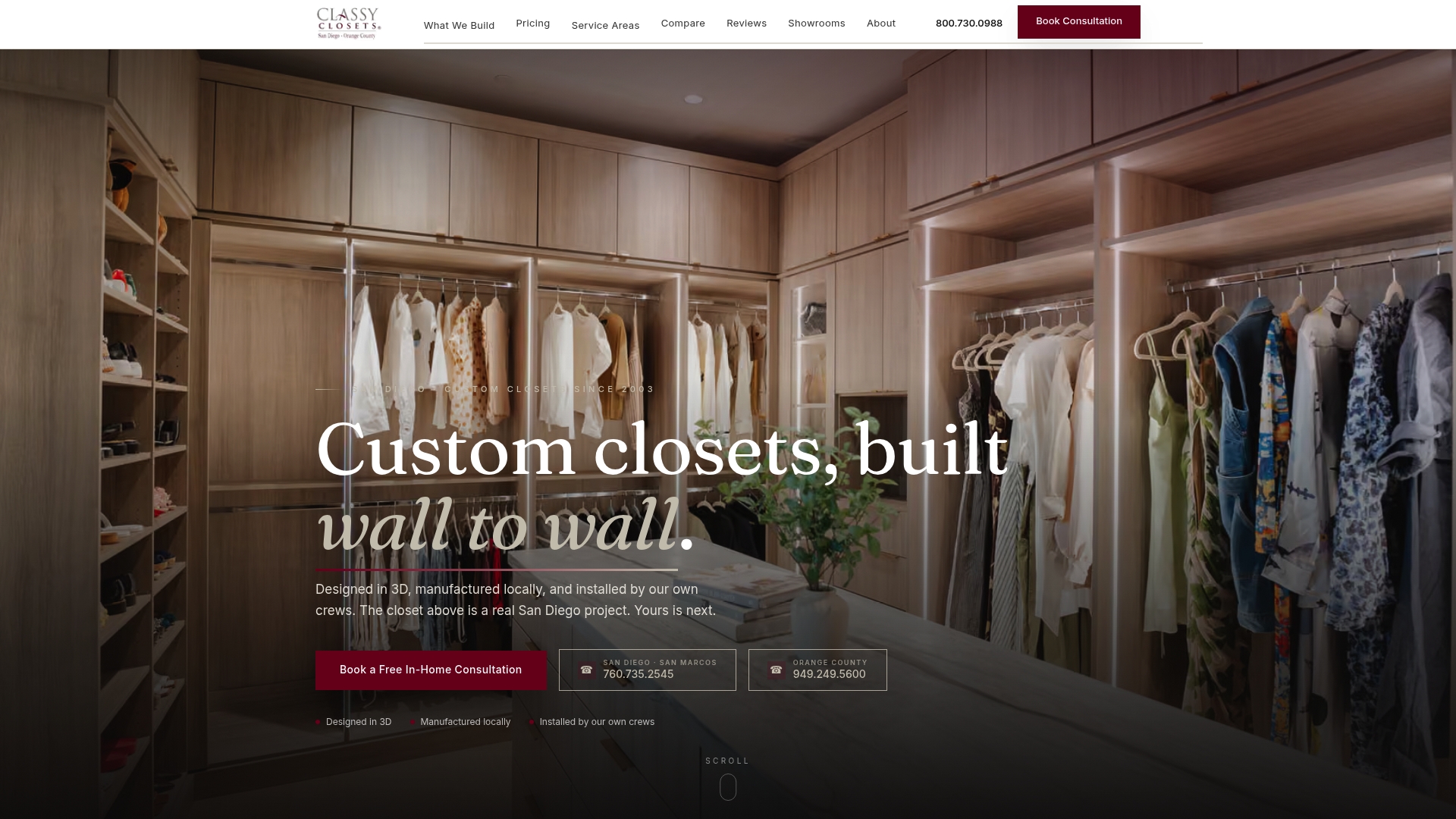
See our custom closets or contact us to book a visit in San Diego or Orange County. We also build pantry, garage, laundry and home office storage if closets are only the first project.
How to decide in five minutes
Ask yourself these questions in order:
- Is this a closet you use every day? Yes points to Elfa or custom. No points to ClosetMaid.
- Do you need to move things around often? Yes points to Elfa, which adjusts along the track.
- Is the budget under about $700 for the whole closet? ClosetMaid is the realistic fit.
- Does the room have odd angles, a slanted ceiling or a wall under 6 feet? A custom design will save you from forced compromises.
- Will you install it yourself? Elfa goes up with fewer holes. Either way, allow a full day and have a second person to help.
If your answers split, rank the closet by importance. Put the strongest system in the closet you use most and the budget option in the spare room.
FAQ
Is Elfa worth the extra money over ClosetMaid?
For a primary closet, usually yes. Reviewers report that Elfa components tend to last longer and the track adjusts more freely. For a guest closet or a short-term home, the price gap is harder to justify, and ClosetMaid does the job.
Is Elfa or ClosetMaid easier to install yourself?
Elfa is generally easier. It needs fewer wall holes and its parts stay sturdy when you move them. ClosetMaid requires more anchor points into studs and takes more effort to remove when you rearrange.
Which one holds more weight?
It depends on the line and how you anchor it. Compare each product’s rated load per linear foot, and aim for at least 30 to 40 pounds per foot on clothing shelves and 30-plus pounds per foot on hanging rods. Anchoring into studs raises capacity on either system.
Can I mix Elfa and ClosetMaid parts?
No. The tracks, standards and brackets are made for their own system and are not interchangeable, so plan the whole closet within one system.
When is a custom closet better than either?
Choose custom when the closet has odd dimensions, when you want drawers and doors that look built in, or when you plan to stay in the home for many years. A free consultation shows you the layout and the itemized price before you decide.
Sources
- ClosetMaid vs Elfa: What the Price Difference Buys
- Elfa vs ClosetMaid Custom Closet System Walk-Ins
- Here’s How The ClosetMaid System Stacks Up To Its Competitors
- The 8 Best Closet Systems to Organize Your Wardrobe
- Best Closet Organizer System: Top 5 Ranked
- Gun Closet Storage: Safe Setup and Organization Guide
- The Best Odor Control for Closets, Bathrooms, and Small Spaces


